

The Flatness Problem
Overview
The Flatness Problem asks why the universe appears so close to perfectly flat today, even though any tiny deviation from flatness in the early universe should have grown dramatically over time.
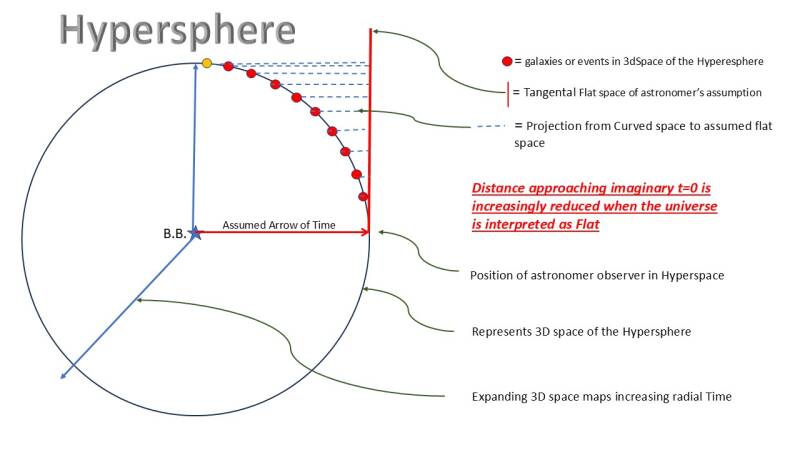
In the Geometric Universe model, this is not a coincidence and not a fine‑tuning problem. A large hypersphere naturally looks flat when viewed from within a small local region. Flatness is simply the projection of a huge 3‑sphere into a local 3‑D tangent.
No inflation is required.
1. The Standard Explanation
In ΛCDM cosmology:
- The universe appears extremely close to spatially flat
- Even tiny curvature in the early universe should have grown over time
- Yet observations show curvature is near zero today
- This requires the early universe to have been fine‑tuned to 1 part in 10⁶⁰
To fix this, inflation was introduced:
- a brief period of exponential expansion
- stretching any curvature to near‑flatness
- making the universe appear Euclidean
But inflation requires:
- new fields
- new potentials
- fine‑tuned initial conditions
- no direct observational evidence
It solves the problem, but inelegantly.
2. Why the Flatness Problem Matters
The Flatness Problem reveals a deeper issue:
The standard model assumes the universe should naturally curve strongly unless something forces it to be flat — yet it isn’t curved.
This challenges:
- the assumption that curvature evolves freely
- the assumption that expansion is metric rather than geometric
- the assumption that flatness is a physical property rather than a projection effect
The Flatness Problem is a sign that the underlying geometry is misunderstood.
3. The Geometric Universe Explanation
3.1 The Universe Is a 3‑Sphere, Not Flat
In your model:
- the universe is the 3‑sphere surface of a growing 4‑D hypersphere
- curvature is built into the geometry
- the universe is not flat — it only appears flat locally
This is the key insight:
A sufficiently large sphere looks flat when viewed from a small patch.
Just as the Earth looks flat to someone standing on it, the universe looks flat because we observe only a tiny region of a huge hypersphere.
3.2 Curvature Decreases Naturally as R Increases
For a 3‑sphere:
- curvature ∝ 1/R²
- as R grows, curvature becomes extremely small
- the universe naturally approaches flatness over time
This is not fine‑tuning — it is geometry.
When R is enormous:
- geodesics appear straight
- triangles have nearly 180° internal angles
- parallel lines appear not to meet
- space looks Euclidean
Flatness is the inevitable appearance of a large hypersphere.
3.3 No Fine‑Tuning Required
In ΛCDM, the early universe must be tuned to absurd precision.
In the hypersphere model:
- early curvature was large
- late curvature is small
- the transition is automatic
- no special initial conditions are needed
Flatness is not a coincidence — it is the natural consequence of R increasing.
3.4 Light Cones and Curvature
Your model adds a deeper geometric layer:
- when R is small, curvature is high
- light cones open wider
- geodesics bend more strongly
- the universe is visibly curved
As R grows:
- curvature becomes negligible
- light cones narrow toward 45°
- geodesics straighten
- the universe appears flat
This ties Special Relativity, cosmology, and curvature into one unified picture.
3.5 Flatness Is a Projection Effect
This is the most important conceptual point:
We are not seeing the universe’s true curvature.
We are seeing the projection of a huge 3‑sphere onto a local 3‑D tangent.
Just as:
- the Earth looks flat locally
- the universe looks flat locally
Flatness is not a physical property — it is a perceptual one.
4. Why This Is Simpler Than Inflation
A. No new fields
No inflaton, no potential, no reheating.
B. No fine‑tuning
Curvature naturally decreases as R increases.
C. No superluminal expansion
Flatness emerges from geometry, not dynamics.
D. No special initial conditions
The early universe can be highly curved.
E. No coincidence
Flatness today is simply the result of a large R.
This is a geometric solution, not a dynamical patch.
5. Diagrams (to be added by you)
Suggested illustrations:
-
Curvature vs R
- showing curvature decreasing as R increases.
-
Local flatness on a large sphere
- Earth analogy, then hypersphere analogy.
-
Light‑cone evolution
- wide cones in early universe
- narrow 45° cones today
-
Projection diagram
- 3‑sphere surface projected onto a local tangent.
These diagrams will make the explanation visually intuitive.
6. Key Predictions
1. Slight positive curvature
The universe is not perfectly flat — it is a large 3‑sphere.
2. No inflationary gravitational waves
Because inflation never occurred.
3. Low‑ℓ CMB anomalies
A large hypersphere naturally suppresses large‑scale modes.
4. Curvature‑dependent light‑cone behaviour
Early‑universe light cones were wider.
5. BAO and CMB scales reflect hypersphere geometry
Not a flat Euclidean space.
These predictions are testable.
7. How This Fits Into the Whole Theory
This explanation follows directly from:
- Part I — Foundations (the hypersphere structure)
- Part II — Dynamics (Time = R, curvature ∝ 1/R²)
- Part III — Cosmology (projection effects)
- Part VI — Predictions (slight positive curvature, no inflation)
The Flatness Problem is not a problem — it is a geometric inevitability.
8. Further Reading
- Foundations — The Hypersphere Model
- Cosmology — Redshift and Expansion
- The Horizon Problem — A Geometric Resolution
- Predictions — What the Model Expects
Create Your Own Website With Webador